How Much Water Does a Dog Need Daily? Normal Intake, Low Water Consumption & Diseases That Can Cause It
Water is one of the most important nutrients for dogs. Adequate hydration is essential for normal blood circulation, body temperature regulation, digestion,…
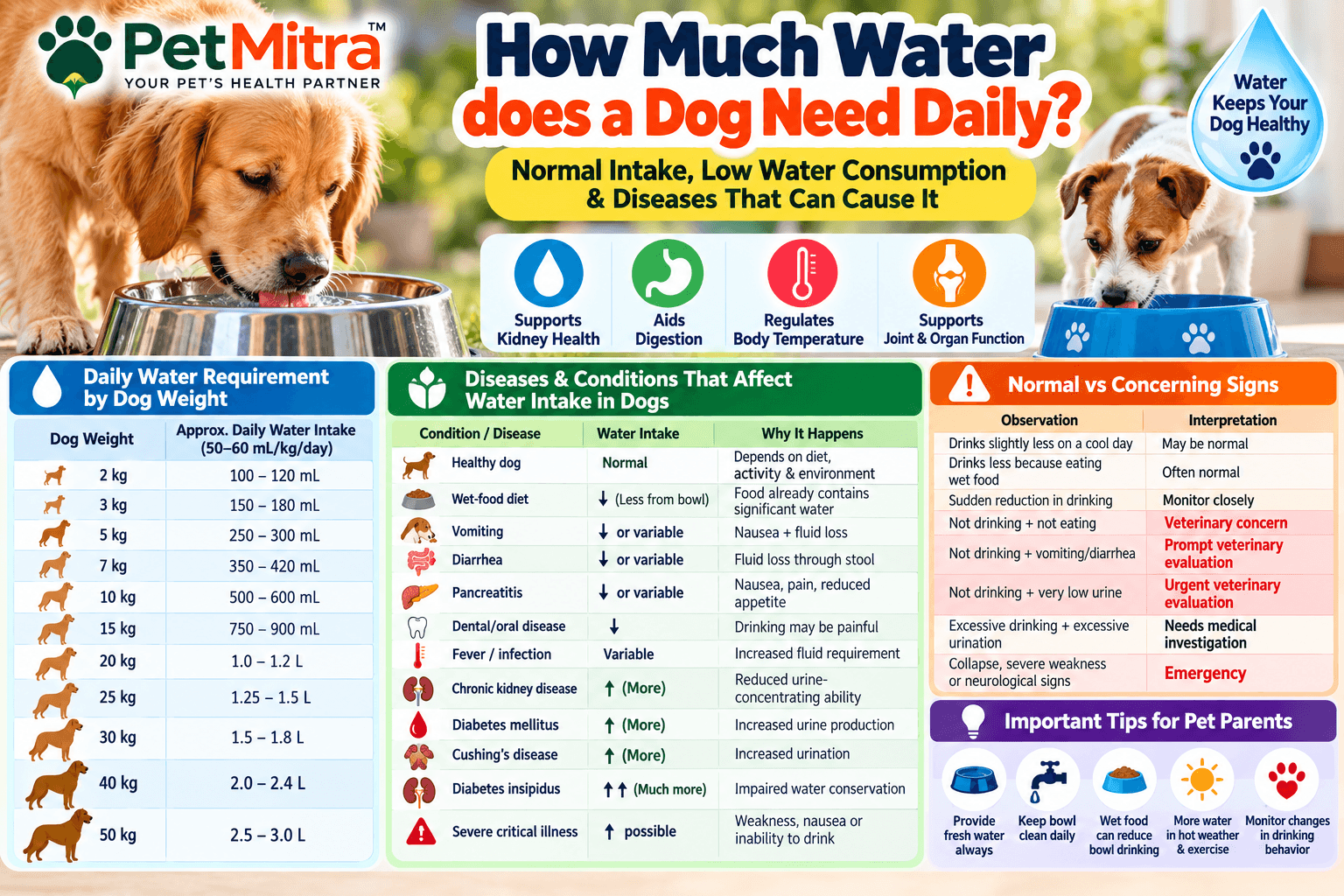
Water is one of the most important nutrients for dogs. Adequate hydration is essential for normal blood circulation, body temperature regulation, digestion, kidney function, electrolyte balance and cellular health.
But how much water does a dog actually need every day?
Many pet parents notice that their dog is drinking less water than usual and immediately become concerned. Sometimes reduced drinking is simply related to diet, weather or activity. In other cases, however, a significant reduction in water intake can occur with illness, pain, nausea, gastrointestinal disease, oral disease or neurological problems.
It is also important to understand that some diseases cause the opposite problem: excessive drinking and urination.
This PetMitra guide explains the approximate daily water requirement for dogs, how to recognize low water consumption, what diseases can cause reduced drinking, how food affects water intake, and when a dog needs veterinary evaluation.
How Much Water Does a Dog Need Every Day?
For a healthy adult dog, a useful general starting estimate is approximately:
50–60 mL of water per kg body weight per day
This is a practical guideline rather than an exact requirement for every dog.
A dog's actual requirement can vary significantly depending on:
Body weight
Age
Diet
Activity level
Environmental temperature
Humidity
Panting
Pregnancy
Lactation
Fever
Vomiting
Diarrhea
Kidney function
Endocrine disease
Medications
Overall health
Daily Water Requirement by Dog Weight
Dog Body WeightApproximate Daily Water2 kg100–120 mL3 kg150–180 mL5 kg250–300 mL7 kg350–420 mL10 kg500–600 mL15 kg750–900 mL20 kg1.0–1.2 L25 kg1.25–1.5 L30 kg1.5–1.8 L40 kg2.0–2.4 L50 kg2.5–3.0 L
These numbers are general reference values. They should not be interpreted as a rigid prescription.
For example, a 20 kg dog may commonly consume around 1–1.2 litres of water per day, but its actual requirement may be higher in hot weather or after exercise.
Important: Drinking Water Is Not the Same as Total Water Intake
This is one of the most important points when evaluating a dog's hydration.
A dog gets water from:
Drinking water
Wet food
Canned food
Homemade food
Moist treats
Water produced during normal metabolism
Therefore, a dog eating a high-moisture diet may drink considerably less from the water bowl than a dog eating dry kibble.
Example
A dog eating primarily dry kibble may obtain relatively little water from its food and therefore drink more.
A dog eating wet food may receive a substantial amount of its daily water requirement through food and may consequently drink less.
Therefore:
Low bowl consumption does not automatically mean dehydration.
The dog's total water intake and hydration status need to be considered.
Why Does a Dog Drink Less Water?
Reduced drinking can have many explanations.
Some are completely normal, while others require veterinary investigation.
Possible reasons include:
Wet-food diet
Cool weather
Reduced activity
Recent dietary change
Stress
Environmental changes
Nausea
Pain
Fever
Dental disease
Oral ulcers
Gastrointestinal disease
Pancreatitis
Infection
Weakness
Neurological disease
Difficulty accessing water
Poor-quality or contaminated water
Certain medications
Severe systemic illness
Is It Normal If My Dog Drinks Less Water for One Day?
Not necessarily a reason for panic.
A healthy dog may occasionally drink less than usual because of:
Cooler weather
Lower activity
Increased moisture in food
Sleeping more
Temporary variation in appetite and activity
However, a persistent or marked reduction in water intake should not be ignored, especially if other clinical signs are present.
Pay particular attention if reduced drinking is accompanied by:
Not eating
Vomiting
Diarrhea
Lethargy
Fever
Pain
Weakness
Dry or tacky gums
Reduced urination
Dark urine
Weight loss
Collapse
Diseases and Conditions That Can Cause Low Water Intake in Dogs
Reduced water consumption is generally a nonspecific clinical sign.
The following conditions can cause a dog to drink less, directly or indirectly.
1. Gastrointestinal Disease
Dogs with gastrointestinal disease may drink less because they feel nauseous or uncomfortable.
Examples include:
Gastritis
Enteritis
Gastroenteritis
Dietary indiscretion
Intestinal obstruction
Severe diarrhea
Severe vomiting
Inflammatory gastrointestinal disease
A dog may simultaneously lose large amounts of fluid through vomiting or diarrhea.
This creates a dangerous combination:
Reduced intake + increased fluid loss = rapid dehydration.
2. Vomiting
A vomiting dog may refuse water because:
Drinking worsens nausea
The stomach is irritated
The dog associates drinking with vomiting
The underlying disease causes anorexia
Repeated vomiting can quickly cause fluid and electrolyte abnormalities.
If a dog cannot keep water down, veterinary assessment is important.
3. Diarrhea
Diarrhea can cause significant fluid loss.
Some dogs with diarrhea continue drinking normally, while others become nauseated and drink less.
Severe diarrhea combined with reduced water intake can lead to:
Dehydration
Electrolyte abnormalities
Weakness
Reduced circulating blood volume
Kidney injury
Puppies are particularly vulnerable to dehydration.
4. Pancreatitis
Dogs with pancreatitis may have:
Reduced appetite
Nausea
Vomiting
Abdominal pain
Lethargy
Reduced water intake
Some dogs may drink excessively, while others drink very little.
A dog with suspected pancreatitis should be evaluated by a veterinarian rather than managed solely by changing its water intake.
5. Dental Disease and Oral Pain
A dog may avoid drinking because moving the mouth or swallowing is painful.
Possible causes include:
Periodontal disease
Broken tooth
Oral ulcer
Gingivitis
Stomatitis
Oral mass
Foreign body
Tongue injury
These dogs may approach the water bowl but hesitate to drink.
Other signs may include:
Bad breath
Drooling
Difficulty chewing
Dropping food
Pawing at the mouth
Reluctance to eat hard food
6. Fever and Systemic Infection
Dogs with significant infection or fever may initially have reduced appetite and water intake.
Examples include:
Bacterial infections
Viral infections
Severe respiratory disease
Systemic inflammatory disease
Sepsis
At the same time, fever and increased respiratory losses can increase fluid requirements.
Therefore, a sick dog drinking less water can become dehydrated rapidly.
7. Pain
Pain can reduce normal eating and drinking behavior.
Possible sources include:
Abdominal pain
Orthopedic pain
Trauma
Postoperative pain
Back pain
Oral pain
Urinary pain
A dog that suddenly stops drinking after surgery or injury should be assessed in context rather than assuming it is simply being fussy.
8. Neurological Disease
Water intake depends partly on normal thirst mechanisms and the ability to locate, approach and drink from a water source.
Neurological disease can interfere with:
Thirst
Behavior
Coordination
Swallowing
Ability to access water
Rare disorders involving the hypothalamus or thirst regulation can produce hypodipsia or adipsia.
Hypodipsia
Hypodipsia means reduced thirst or reduced drinking.
Adipsia
Adipsia means absence or near absence of normal thirst.
These conditions are uncommon but clinically important because water balance can become severely abnormal.
9. Severe Weakness or Critical Illness
Critically ill dogs may not drink normally because they are:
Weak
Depressed
Sedated
Unconscious
Nauseated
In pain
Unable to reach a water bowl
This is particularly important in hospitalized patients.
A dog that is physically unable to drink should not simply be left without fluid support. The veterinarian must assess hydration, perfusion and fluid requirements.
10. Dehydration Can Paradoxically Reduce Drinking
A severely ill dog may become dehydrated and still not drink enough voluntarily.
This can happen with:
Severe gastrointestinal disease
Weakness
Nausea
Neurological disease
Critical illness
Therefore, a dog cannot always be relied upon to drink enough water to correct dehydration.
What About Kidney Disease?
Kidney disease requires special attention because the relationship between kidney disease and water consumption can be complex.
Dogs with chronic kidney disease commonly develop:
Increased thirst + increased urination
This occurs because the kidneys become less able to concentrate urine.
Therefore, chronic kidney disease is more classically associated with polydipsia, not simply low water consumption.
However, a dog with kidney disease can also drink poorly if it becomes:
Nauseated
Uremic
Weak
Dehydrated
Acutely ill
This can make kidney function deteriorate further.
So:
A kidney patient that suddenly stops drinking is a veterinary concern.
Can Diabetes Cause Low Water Intake?
Diabetes mellitus is classically associated with:
Increased thirst
Increased urination
Increased appetite in some cases
Weight loss
Therefore, diabetes is generally a cause of increased, rather than decreased, water intake.
However, a diabetic dog that becomes sick and stops eating or drinking may have a serious complication and requires prompt veterinary assessment.
What About Cushing's Disease?
Hyperadrenocorticism, commonly called Cushing's disease, is typically associated with:
Increased thirst
Increased urination
Increased appetite
Panting
Abdominal enlargement
Muscle weakness
Skin and coat changes
Again, this is usually increased water consumption, not low consumption.
Diseases That Commonly Cause Increased Water Intake
It is useful to distinguish reduced drinking from excessive drinking.
Increased water consumption can occur with:
Chronic kidney disease
Diabetes mellitus
Hyperadrenocorticism
Diabetes insipidus
Liver disease
Hypercalcemia
Pyometra
Certain medications
Some urinary disorders
Therefore, a change in drinking behavior in either direction can be clinically relevant.
How Do You Know If Your Dog Is Dehydrated?
Water intake alone cannot diagnose dehydration.
A veterinarian may assess:
Mucous membranes
Capillary refill time
Skin elasticity
Heart rate
Pulse quality
Eye appearance
Body weight
Urine output
Blood pressure
Packed cell volume
Total solids
Serum electrolytes
Kidney parameters
Overall perfusion
Possible signs of dehydration
Pet owners may notice:
Dry or tacky gums
Lethargy
Weakness
Reduced appetite
Reduced urination
Darker urine
Excessive panting
Sunken-looking eyes in more significant dehydration
However, physical signs can be unreliable, especially in certain patients.
How Can You Measure Your Dog's Water Intake at Home?
If you are concerned about water consumption, measuring it for 24 hours can provide useful information for your veterinarian.
Simple method
Measure how much water you put into the bowl.
Record any water added during the day.
Measure the remaining water after 24 hours.
Account for other water sources.
Record whether the dog is eating wet or dry food.
Note vomiting, diarrhea or unusual urination.
Calculate:
Water consumed (mL) ÷ body weight (kg) = mL/kg/day
This is more clinically useful than saying:
"My dog drinks two bowls."
because bowl sizes vary.
Example: Measuring Water Intake
Suppose a dog weighs 20 kg.
If it drinks approximately 1,000 mL in 24 hours:
1,000 ÷ 20 = 50 mL/kg/day
That falls within a commonly used general reference range.
But if the dog suddenly drops from its usual intake to 300 mL/day while also vomiting and refusing food, the change is clinically more important than the absolute number alone.
Does Dry Food Make Dogs Drink More?
Usually, yes.
Dry kibble contains much less water than canned or fresh food.
Therefore, dogs eating primarily dry food generally obtain more of their water from drinking.
Dogs eating wet food may drink less because they receive a significant amount of water directly from the diet.
This is why comparing drinking behavior between two dogs without considering their diets can be misleading.
Does Hot Weather Increase Water Requirements?
Yes.
Dogs may require more water in hot weather because of:
Panting
Increased respiratory water loss
Increased activity
Environmental heat
Increased body temperature
Dogs exercising outdoors in hot weather require especially careful access to fresh water.
Never intentionally restrict water to prevent a dog from urinating more frequently during hot weather.
Do Puppies Need More Water?
Puppies can be particularly vulnerable to dehydration because they have smaller body reserves and can deteriorate rapidly with:
Vomiting
Diarrhea
Poor feeding
Infection
Fever
A puppy that is refusing water and food or has repeated vomiting/diarrhea should be assessed promptly.
Do not rely on home hydration remedies when a young puppy is clinically ill.
Do Pregnant and Lactating Dogs Need More Water?
Yes.
Water requirements can increase during:
Pregnancy
Lactation
Lactating females may require substantially more water because milk production involves significant fluid transfer.
Fresh water should be continuously available.
A nursing female that suddenly stops drinking, especially with fever, lethargy, abnormal mammary glands or poor appetite, requires veterinary evaluation.
What If My Dog Drinks Very Little But Eats Wet Food?
This may be normal.
Wet food contains a substantial amount of water.
For example, a diet with high moisture content can significantly reduce the amount of water the dog needs to obtain directly from the bowl.
Therefore, assess:
Total water intake = drinking water + water from food + other relevant sources.
If the dog is active, eating normally, urinating normally and has no signs of dehydration, low bowl consumption alone may not indicate disease.
How Can You Encourage a Dog to Drink More Water?
If a healthy dog simply drinks less than expected, you can try:
Providing fresh water frequently
Washing the bowl daily
Offering multiple water bowls
Using a clean, appropriate water fountain
Placing water in quiet, accessible locations
Adding moisture through appropriate wet food
Adding a small amount of veterinarian-approved water or broth to food
Important
If a dog is sick and refusing water, do not spend too much time trying home tricks while delaying veterinary care.
The underlying cause needs to be identified.
Should You Force Water Into a Dog's Mouth?
Generally, do not force large amounts of water into a dog's mouth.
There is a risk of aspiration if water is administered incorrectly, particularly in:
Weak dogs
Neurologically compromised dogs
Dogs that are vomiting
Dogs with swallowing problems
Unconscious or heavily sedated animals
If oral hydration is inadequate, a veterinarian can determine whether the dog requires appropriate fluid therapy.
When Is Low Water Intake an Emergency?
Seek veterinary attention promptly if reduced drinking occurs together with:
Repeated vomiting
Severe diarrhea
Blood in vomit or stool
Extreme lethargy
Collapse
Difficulty breathing
Severe abdominal pain
Very low urine production
Inability to urinate
Pale or abnormal gums
High fever
Neurological signs
Seizures
Severe weakness
Suspected toxin exposure
Heatstroke
Especially important
A puppy, geriatric dog or dog with kidney disease, diabetes or another chronic illness can deteriorate more quickly.
Low Water Intake vs Increased Water Loss
This distinction is clinically important.
A dog can become dehydrated because:
Intake decreases
Not drinking
Not eating
Nausea
Pain
Neurological disease
Losses increase
Vomiting
Diarrhea
Excessive urination
Panting
Fever
Hemorrhage
Burns or other fluid losses
Both can happen simultaneously
For example:
Parvoviral enteritis → vomiting + diarrhea + reduced drinking
This combination can cause severe dehydration rapidly.
When a Dog Drinks Less Water: What Should the Veterinarian Check?
Depending on the history and clinical examination, the veterinarian may consider:
Physical examination
Hydration status
Temperature
Heart rate
Respiratory rate
Mucous membranes
Abdominal examination
Oral examination
Body weight
Laboratory testing
Depending on the case:
CBC
Serum biochemistry
Urea/BUN
Creatinine
SDMA
Electrolytes
Glucose
Liver parameters
Urinalysis
Urine specific gravity
Additional tests when indicated
Abdominal ultrasound
Radiography
Infectious disease testing
Pancreatic testing
Endocrine testing
Neurological evaluation
Testing should be based on the dog's clinical signs rather than performed automatically in every case.
Water and Urine: Why Both Matter
Water intake and urine output are closely connected.
A veterinarian may want to know:
How much the dog drinks
How frequently it urinates
Approximate urine volume
Urine color
Urine concentration
Whether urination is painful
Whether accidents are occurring
A dog that drinks less and produces very little urine may have a different clinical problem from a dog that drinks less but continues to urinate normally.
Important Difference: Oliguria vs Low Water Intake
These terms should not be confused.
Low water intake
The dog is consuming less water.
Oliguria
The dog is producing an abnormally low amount of urine.
A dog can have low water intake without oliguria.
Conversely, a dog with kidney disease may have significant changes in urine production despite drinking normally or excessively.
This distinction is important in clinical evaluation.
Can Low Water Intake Cause Kidney Problems?
Yes, significant or prolonged dehydration can compromise kidney perfusion.
Severe dehydration can reduce circulating blood volume and renal perfusion, potentially contributing to pre-renal azotemia.
If dehydration is severe or prolonged, kidney injury may develop.
Therefore, a dog with persistent poor water intake should not be ignored.
Is Drinking Less Always Bad?
No.
A dog may naturally drink less when:
The weather is cooler
Activity is lower
It is eating wet food
It is receiving more moisture through food
Its normal requirement is temporarily lower
The key is to evaluate the overall clinical picture and change from the dog's normal pattern.
A sudden and persistent change is more concerning than a small day-to-day variation.
Key Takeaways for Pet Parents
Normal reference
A healthy adult dog may commonly require approximately:
50–60 mL/kg/day
but individual requirements vary.
Remember
Water from food also counts.
Low drinking can occur with:
Nausea
Vomiting
Diarrhea
Pancreatitis
Dental/oral pain
Fever
Infection
Pain
Neurological disease
Severe weakness
Critical illness
Some diseases usually cause increased drinking:
Chronic kidney disease
Diabetes mellitus
Cushing's disease
Diabetes insipidus
Hypercalcemia
Some liver and urinary disorders
Emergency warning
If reduced drinking occurs with vomiting, diarrhea, weakness, collapse, severe pain, abnormal urination or other serious signs, veterinary assessment should not be delayed.
Final Answer: How Much Water Does a Dog Need?
For many healthy adult dogs, approximately 50–60 mL/kg/day is a useful general reference for total daily water needs, but there is considerable individual variation.
A 10 kg dog may therefore require roughly 500–600 mL/day, while a 20 kg dog may require approximately 1–1.2 litres/day.
However, this includes the broader concept of daily water requirement, and the amount actually consumed from the water bowl depends heavily on diet.
A dog eating wet food may drink much less than a dog eating dry kibble.
The most important concern is not a single low reading but a persistent or sudden change in drinking behavior, especially when accompanied by vomiting, diarrhea, poor appetite, lethargy, pain, reduced urination or other clinical abnormalities.
If your dog is drinking significantly less than usual and appears unwell, do not assume that simply encouraging it to drink more will solve the problem. The underlying cause should be evaluated.
PetMitra Veterinary Disclaimer
This article is intended for general educational and informational purposes only and is not a substitute for veterinary examination, diagnosis or treatment. Water requirements vary between individual dogs depending on body weight, diet, environmental temperature, activity, age, pregnancy/lactation, medications and underlying disease.
The approximate 50–60 mL/kg/day figure is a general reference and should not be used as a rigid fluid prescription for a sick animal.
Dogs with kidney disease, diabetes, heart disease, gastrointestinal disease, endocrine disorders, urinary abnormalities or other medical conditions may have different fluid requirements.
If your dog has stopped drinking, cannot keep water down, is severely weak, is vomiting repeatedly, has persistent diarrhea, is urinating very little, cannot urinate, or shows signs of dehydration or serious illness, contact a qualified veterinarian promptly.
PetMitra – Your Pet's Health Partner
Veterinary Consultation • Pet Vaccination • Pet Surgery • Diagnostics • Emergency & Critical Care • Grooming • Pet Care